How to Judge a Skort in the Fitting Room in Four Movements
Quick Answer: Do four things before you buy: sit down fully and check where the skirt layer lands, take a wide lunging step and check whether the inner short rides, reach overhead to test whether the waistband migrates, and walk ten paces to see whether the skirt layer twists. The most common skort failures - riding, twisting and gaping - are all invisible standing still and all obvious within these four movements.
It looked perfect in the mirror and rode up within twenty minutes of the first wear.
The fitting room told you nothing because you only stood in it.

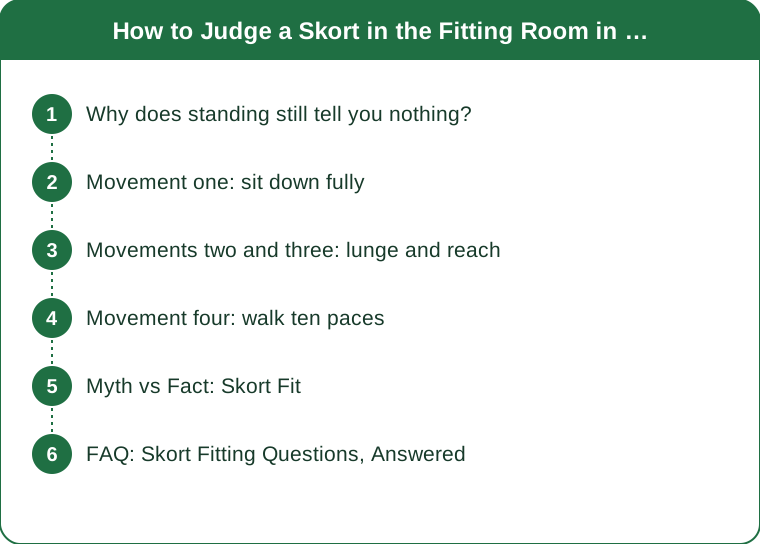
Why does standing still tell you nothing?
Because a skort is two garments with different behaviours, and the problems come from how they interact when you move.
The skirt layer is loose and moves with air and momentum. The inner short is fitted and moves with your legs. They do not travel together.
Riding up happens when the inner short’s fabric grips the thigh and gets carried upward with each stride, which requires strides to observe.
Twisting happens when the skirt layer rotates around the waistband, usually because of an asymmetric seam or a waistband that is too loose.
Gaping at the waist appears when you bend, which is the moment nobody tests in a fitting room.
All four are predictable in ninety seconds if you know what to do. Standing and turning does not qualify.
Movement one: sit down fully
Sit on the fitting room bench with your knees at 90 degrees and look down.
Check where the skirt layer lands. It will ride up considerably when sitting, and the question is whether the inner short covers what the skirt no longer does.
Check the inner short’s leg opening. If it has ridden to the crease of your hip when seated, it will ride during activity too.
Check the waistband at the back. Sitting is when a low or thin waistband gaps, and this is the most common reason people abandon a skort.
Cross your legs and check again, which is a harder test and is what will happen at a cafe.
A skort that passes the seated test passes most of daily wear, because sitting is the position that exposes coverage problems fastest.
Movements two and three: lunge and reach
Take a wide step forward into a lunge, as deep as the fitting room allows.
Watch the inner short. If it climbs and stays climbed rather than settling back, the leg opening is too loose or the fabric is too grippy for its cut.
Check for the front seam pulling, which indicates insufficient rise or a missing gusset and will chafe within an hour.
Then reach both arms straight overhead and hold for five seconds.
Watch the waistband. If it rolls, slides down, or the skirt layer lifts noticeably at the front, the waistband is not holding and no amount of adjusting will fix it later.
Do both movements twice. The second repetition often reveals a slow migration that the first hides.

Movement four: walk ten paces
Walk the length of the fitting room and back, at your normal pace.
Watch for the skirt layer rotating. If the front seam has moved off centre by the time you turn around, it will keep rotating all day.
Listen for fabric noise, which some technical fabrics produce and which is far more noticeable outside a shop than inside one.
Feel for the inner short’s hem catching on your thigh. A hem that grabs on each stride is the mechanism behind riding up, and it is a fabric and cut issue rather than a size issue.
Check the hem line in the mirror after walking, not before - a skirt hem that hangs unevenly after movement was cut on grain badly.
And if the shop allows it, take a photo from behind. The back is where coverage problems live and it is the view you cannot assess yourself.
Myth vs Fact: Skort Fit
Myth: a skort that rides up is too small. Fact: it is more often too loose in the inner short’s leg opening, or made from a fabric that grips skin. Sizing up frequently makes riding worse, not better.
Myth: longer inner shorts always ride less. Fact: the leg opening’s grip and the fabric matter more than the length. A short inner leg with a good elastic hem can outperform a longer one with a loose opening.
Myth: the skirt layer length is the main coverage decision. Fact: the inner short is what actually provides coverage in movement. The skirt layer is styling, and treating it as coverage is how people end up uncomfortable.
Myth: skorts are only for tennis and golf. Fact: they have been a mainstream casual and travel piece for years, and the fit criteria are the same wherever you wear one.
Myth: an attached inner short is always better than separate. Fact: attached only at the waistband is common and works well; fully attached at the hem restricts movement. Check which construction you are buying.
Myth: you can tell from the product photos. Fact: product photos are almost universally shot standing still, which is the one position that reveals nothing. The four movements exist precisely because photography does not do them.
FAQ: Skort Fitting Questions, Answered
Why does my skort’s inner short ride up more than regular shorts?
Because the skirt layer sits over it and adds friction from above while your thigh provides friction from below, so the short gets pushed upward from both directions. A grippier leg hem is the usual fix.
Should I size up or down in a skort?
Neither by default - fit the waistband and then check the inner short’s leg opening separately. Most skort problems are cut problems, not size problems.
What length works for most people?
Something that hits mid-thigh with an inner short an inch or two shorter. Very short skorts are harder to wear in movement, and very long ones tangle at the knee.
Can I wear a skort into autumn?
Yes, with tights or long socks and a longer layer on top - it is a common transitional approach in late September and works better than most people expect.
How do I stop the skirt layer from twisting?
Check the waistband tension first, since a loose waistband allows rotation. Skorts with a side seam alignment and a slightly firmer waistband twist far less.
Is the built-in short supposed to be tight?
Snug, not tight. It needs enough grip not to move, and enough room not to dig at the leg opening. If it leaves deep marks after an hour, it is too tight.
TL;DR:
- Standing still reveals none of the problems a skort will develop.
- Sit fully and check coverage, waistband gaping, and inner short position.
- Lunge wide and see whether the inner short climbs and stays climbed.
- Reach overhead to test whether the waistband holds.
- Walk ten paces and watch for skirt rotation and hem catching.
- Riding up is usually a loose leg opening, not a size problem - sizing up makes it worse.
Ninety seconds of moving in the fitting room replaces a month of finding out.
See It in Motion
Seen here: UPF 50+ Adjustable A-Line Running Skort with Pockets — shop it on bubblelime.com
Keep Reading
This article is for general informational and styling purposes only. Fit, sizing, and product availability may vary.