How to Keep Wearing a Skort Once the Temperature Drops
Quick Answer: A skort works into autumn if you layer underneath rather than over: opaque tights of 60 to 100 denier, or a fitted legging under the skort for genuinely cold days. The rules that matter are matching the tights to the liner colour so nothing shows at the hem, choosing a thicker skort fabric than you wore in summer, and pairing with boots rather than trainers to shift the whole look out of summer sport.
The skort solves a specific problem — the coverage of shorts with the look of a skirt, and no ride-up when you move.
That problem does not disappear when the temperature does. But most people put the skort away in September and go back to leggings.
There is a straightforward autumn version, and it comes down to what goes underneath.

What goes underneath, and how thick?
Two options, split by how cold it actually is.
Opaque tights, 60 to 100 denier, for roughly 10 to 18°C. Sixty denier is genuinely opaque and reads as a considered choice rather than a compromise; below 40 denier looks like summer tights and defeats the purpose.
A fitted legging underneath, for below about 10°C, or for anything active. Full length, close fitting, in a colour that works with the skort.
The critical detail either way is colour matching against the liner. A skort has built-in shorts underneath, and if those are black while your tights are navy, the mismatch shows at every step. Match the tights to the liner, not to the outer skirt, which is the opposite of most people’s instinct.
Fleece-lined tights are the underrated option — genuinely warm, and from the outside identical to ordinary opaque tights.
Does the skort itself need to change?
Yes, and this is where autumn skort styling either works or does not.
Summer skorts are built from lightweight technical fabric — thin, quick-drying, often slightly sheer. Over tights in October, that thin fabric reads as unmistakably out of season regardless of what you do underneath.
Look for heavier constructions: ponte, scuba, a heavier jersey, or a woven skort in a twill or corduroy. The garment structure is the same; the fabric weight moves it out of summer.
Pleated skorts work particularly well in autumn, because pleating reads as a skirt detail rather than a sport one and carries a heavier fabric well.
Length helps too. A slightly longer skort — mid-thigh rather than high — sits better with tights and boots and covers more of the transition point where the tights start.
What shoes make it work?
Boots, and that single change does most of the seasonal work.
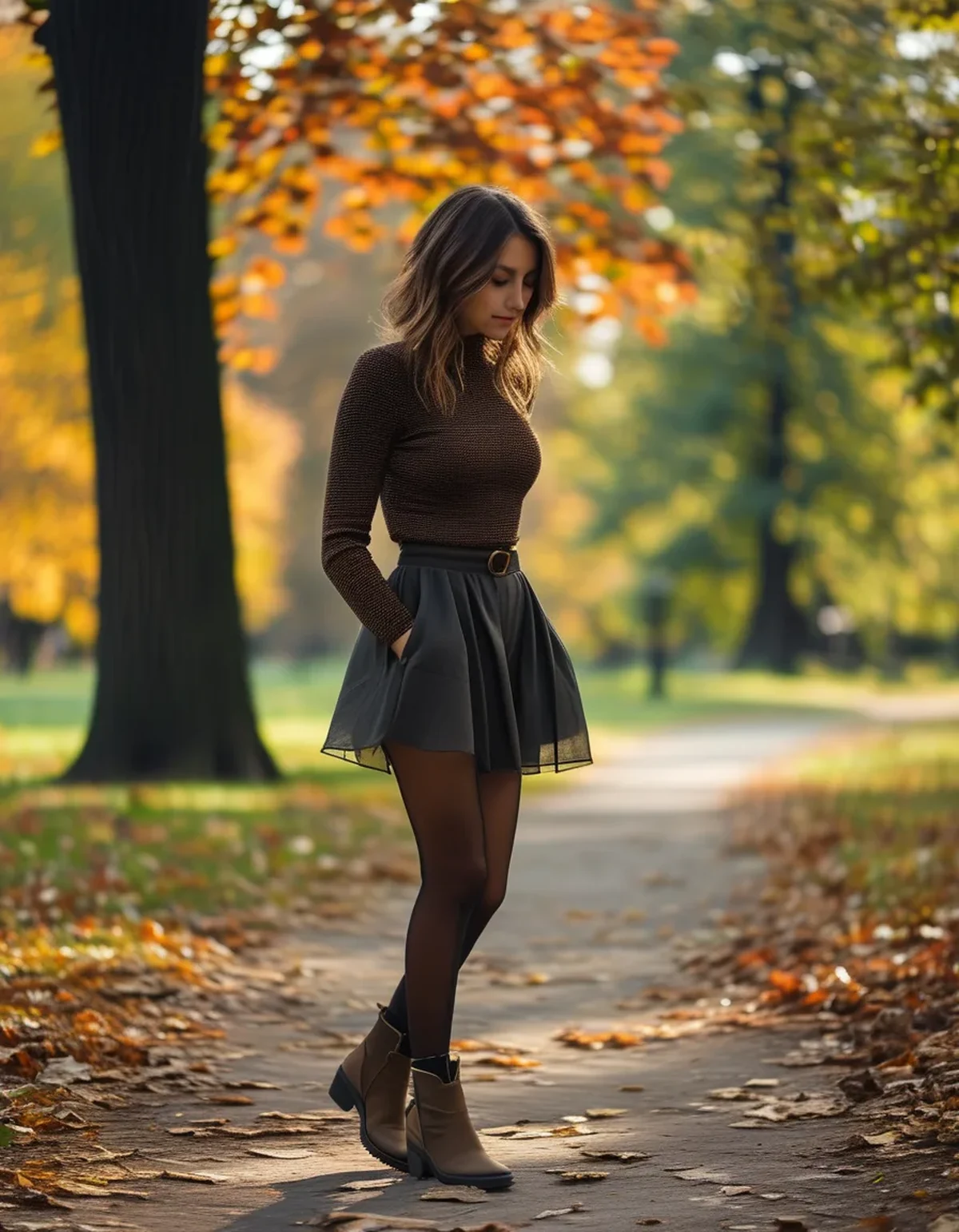
Ankle boots are the reliable choice — they close the outfit at the bottom, add visual weight to match the heavier fabric, and immediately move the whole look out of tennis-court territory.
Knee boots work with a shorter skort and are the dressiest version of this.
Trainers can work, but only with a heavier skort and opaque tights, and they keep the outfit firmly in the sporty register. If that is what you want, it is fine — chunky trainers rather than thin running shoes.
What does not work is a sandal or a thin sock trainer, which fights everything else you have done.
Sock height matters with ankle boots. A visible thin sock over tights adds a horizontal line at the ankle; either invisible socks or a boot that covers the join.
How do you layer on top without ruining the proportion?
Keep the volume above and the line below.
A skort is a relatively structured, short lower half, which means it pairs best with a top layer that has some volume — an oversized knit, a cropped jacket, a boxy overshirt.
Do not add a long layer that covers the skort entirely. A coat past the hem hides the garment and leaves you looking like you are wearing tights and boots, which is the most common failed version of this outfit.
A cropped or waist-length jacket is the safest, because it ends above the skort and keeps the skirt visible.
For a long coat, wear it open so the vertical line frames the skort rather than hiding it, and accept that once it is buttoned the outfit is a coat.
One more: a tucked or half-tucked top defines the waist, which matters because the skort’s own waistband is usually sporty and flat. A defined waist is what shifts it from athletic to styled.
Myth vs Fact: Skorts in Cold Weather
Myth: a skort is a summer-only garment. Fact: it is a construction, not a season. Ponte and twill skorts with tights are a standard autumn look in tennis and golf-adjacent style, and have been for years.
Myth: tights under a skort looks like a school uniform. Fact: that comes from thin tights and a pleated mini together. Heavier fabric, 60 denier or more, and boots removes the association entirely.
Myth: you need to size up to fit tights underneath. Fact: tights add almost nothing. A legging underneath might need a slightly looser skort, but tights do not — if the skort is tight over tights, it was tight before.
Myth: the liner makes tights redundant. Fact: the liner is a thin technical short for coverage, with no warmth at all. It is not a base layer.
Myth: skorts only work for sport. Fact: the sport version has thin fabric and a flat waistband. A woven skort in a heavier fabric is just a skirt with practical shorts underneath, which is arguably better than a skirt for autumn wind.
FAQ: Autumn Skort Questions, Answered
What denier should I actually buy?
Sixty denier is the sweet spot — properly opaque, warm enough for most autumn days, and available everywhere. Go to 100 or fleece-lined for genuine cold. Below 40 denier is a summer tight and will look like one no matter what else you are wearing.
Can I wear a skort for actual outdoor sport in autumn?
Yes, and this is where it beats a skirt or shorts outright — the liner prevents ride-up and the tights add warmth without restricting movement. For running or tennis in the cold, a skort over a fitted legging is a genuinely good combination that a lot of players use.
How do I stop the tights showing a different colour at the hem?
Match the tights to the liner shorts, not to the outer skirt. The liner is what shows when you move, and a mismatch there is what makes the whole thing look accidental. Black liner, black tights is the safe default, and most skorts have a black liner regardless of outer colour.
TL;DR:
- Layer underneath, not over. 60 to 100 denier opaque tights for mild autumn, a fitted legging under the skort for real cold.
- Match the tights to the liner colour, not the outer skirt — the liner is what shows when you move.
- Switch to a heavier skort fabric — ponte, twill, scuba. Thin technical fabric over tights reads as out of season no matter what.
- Boots rather than trainers, and keep the top layer cropped or worn open so it does not hide the skort entirely.
The whole seasonal shift is really two purchases: one pair of 60 denier tights and one heavier skort. Everything else you already own.
See It in Motion
Seen here: UPF 50+ Adjustable A-Line Running Skort with Pockets — shop it on bubblelime.com
Keep Reading
This article is for general informational and styling purposes only. Fit, sizing, and product availability may vary.