Why a Skort That Fits Your Waist Can Still Twist When You Walk
Quick Answer: A skort has two independent layers attached at one waistband, and they respond to leg movement differently — the fitted inner short follows the thigh while the outer skirt swings free. When friction between the layers is high and the outer skirt’s hem circumference is small relative to your stride, that mismatch accumulates into rotation. Fit at the waist doesn’t prevent it because the twisting originates at the hem.
The fitting-room test was perfect. Twenty minutes into a walk, the pleat that was centered is now on your left hip, and you’re doing the discreet realignment tug every few blocks.

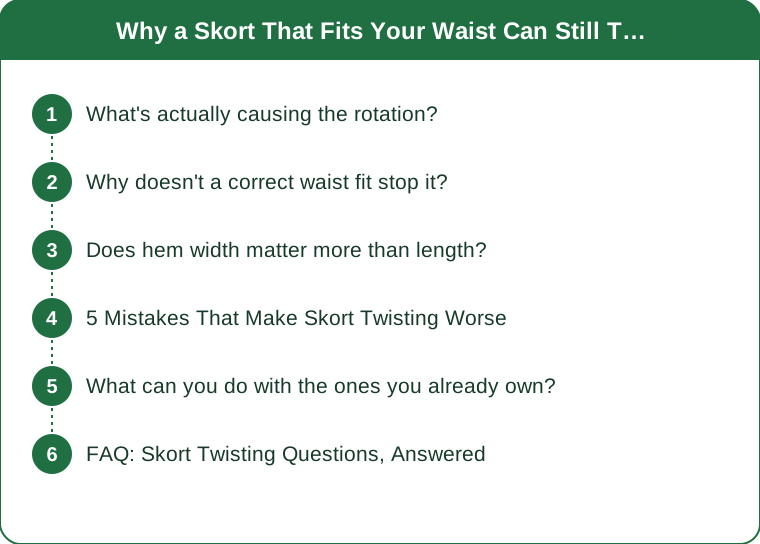
What’s actually causing the rotation?
A mismatch in how two layers move, compounded over hundreds of strides.
The inner short is fitted and moves with your thigh. Every step rotates it slightly with the leg, and because it grips the skin it returns most of the way but not all of it.
The outer skirt is free-hanging and swings in response to hip motion, air resistance, and its own momentum. It has no reason to return to a starting position.
Between them is friction. When the inner short drags the outer skirt fractionally with each stride and nothing pushes it back, you get a slow, one-directional creep. Most people walk with a slight asymmetry in stride length or hip rotation, which is why it consistently migrates one way rather than oscillating.
Why doesn’t a correct waist fit stop it?
Because the waistband is a pivot, not an anchor.
A snug waistband stops the whole garment from sliding down. What it can’t do is prevent rotation around the vertical axis — the band can be perfectly sized and still allow the entire skort to turn, especially over smooth synthetic fabric or a slippery base layer.
In fact, an extremely tight waistband can make it worse in one specific way: it compresses the outer skirt against the inner short at the top, increasing the friction that transmits the inner layer’s rotation outward.
What actually resists rotation is friction against your body at the waist and a hem wide enough not to be dragged by the thigh. A silicone grip strip, a slightly textured band, or a high-rise band sitting on skin rather than over a tucked shirt all help more than tightness does.
Does hem width matter more than length?
It does, and it’s the specification nobody publishes.
A skort’s outer skirt has a hem circumference. If that circumference is close to the maximum width your thighs reach during a stride, the fabric contacts your leg on every step and gets pushed sideways.
A-line and pleated skirts with generous sweep clear the thigh entirely, so nothing drags. Straight or slightly tapered skirts — the ones that look sleekest standing still — are the ones that twist.
Quick test in the fitting room that beats any mirror check: take an exaggerated stride, then a second one, and watch whether the hem brushes your thigh. If the fabric touches your leg mid-stride, it will twist over an hour. Standing still tells you nothing about this.
The same logic explains why the problem is worse on hills and worse walking fast — both increase stride length and hip rotation.

5 Mistakes That Make Skort Twisting Worse
1. Sizing up for comfort. A looser waistband rotates more freely. If the band is spinning, going up a size makes it spin faster.
2. Tucking a shirt underneath the band. Fabric-on-fabric at the waist is dramatically more slippery than fabric-on-skin. Tuck over, not under, or don’t tuck.
3. Wearing it over a base layer or bike shorts. Same problem, one layer lower. The whole assembly now has nothing to grip.
4. Using fabric softener. It coats fibers and reduces the inter-layer friction that would otherwise be somewhat self-correcting — but more importantly, it makes the band slip on skin.
5. Judging fit standing still. Every skort fits standing still. Walk ten steps in the fitting room, including one long stride, before deciding.
What can you do with the ones you already own?
Add grip at the waistband. Iron-on silicone grip tape, sold for hemming and for cycling shorts, applied to the inside of the band in two or three 2-inch strips. This is the highest-impact fix and it’s reversible.
Tack the layers at the side seams. Two or three hand stitches joining inner short and outer skirt at each side seam, about 3 inches down from the waistband. It stops relative rotation without affecting how either layer moves at the hem. Ten minutes with a needle.
Wear it directly against skin at the waist. No tucked shirt, no base layer under the band.
Reserve straight-cut skorts for lower-output activities — errands, casual wear, anything without a long stride — and keep pleated or A-line cuts for walking, hiking, and sport.
And when buying: pleats, sweep, and a grip-lined band are the three features that predict a skort will stay where you put it. None of them are visible in a product photo, which is why this keeps happening.
FAQ: Skort Twisting Questions, Answered
Is this a sizing problem I could solve by trying a different size?
Rarely. Twisting is driven by hem width relative to stride and by waistband grip, and neither improves much with a size change. Sizing down tightens the band but doesn’t add friction against skin, which is what actually matters.
Why does it only twist one direction?
Most people have a slightly asymmetric gait — one hip rotating a few degrees more than the other, or a longer stride on one side. That small consistent bias accumulates in one direction over hundreds of steps.
Do tennis skorts twist less?
Generally yes, because sport-specific cuts have more sweep and almost always include grip elastic. They’re designed around lateral movement, which is a harsher test than walking. If you twist badly in lifestyle skorts, a sport-cut one is worth trying.
TL;DR:
- Twisting comes from two layers moving differently, not from a wrong waist size.
- The waistband is a pivot; friction against skin is what actually resists rotation.
- If the hem touches your thigh mid-stride, it will twist — test with a long stride, not a mirror.
- Silicone grip tape inside the band, or a few tacking stitches at the side seams, fixes most pairs.
The frustrating part of this problem is that everything you can check while shopping looks fine, and the thing that predicts failure is invisible until you’re a mile from home. Take ten walking steps in the fitting room. It’s the only test that has ever told anyone anything useful about a skort.
See It in Motion
Seen here: UPF 50+ Pleated Running Skort with 26” Leggings & Pockets — shop similar styles on bubblelime.com
Keep Reading
This article is for general informational and styling purposes only. Fit, sizing, and product availability may vary.