Why a Skort That Works for Tennis Fails on a Long Walk
Quick Answer: Tennis skorts are built for short bursts, lateral movement, and frequent stopping — so they prioritize a stiffer outer layer and a shorter, grippier inner short. Walking involves thousands of repetitive strides in one plane, which turns a grippy inner layer into friction and a stiff outer into a hem that rides. The two use cases want opposite specifications.
Your tennis skort is perfect on court and unbearable by mile two of a walk. That’s not a quality problem — you’re using a garment designed for a different movement pattern.

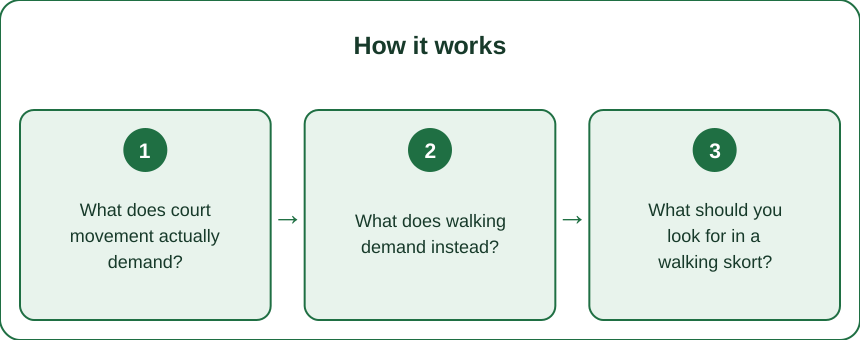
What does court movement actually demand?
Explosive, multi-directional, and intermittent — and those three things drive the whole design.
Lateral stability. A tennis skort needs the inner layer to stay put through sudden side-to-side movement. That means a grippier inner short, usually with silicone at the hem or a tighter compression fit.
A shorter inner short. Court movement involves deep lunges and wide stances, and a longer inner layer bunches at the top of the thigh in those positions.
A stiffer outer layer. Structure keeps the skirt from flying up during serves and overhead reaches. Stiffness serves the aesthetic and the function.
Ball pockets. Which add weight and bulk at the hip or thigh.
Intermittent load. Points last seconds and there’s a break between them. Nothing has to be comfortable for forty continuous minutes.
What does walking demand instead?
Almost the inverse, because the movement pattern is repetitive and continuous.
Low friction at the inner thigh. Walking is thousands of identical strides. Anything grippy against the skin becomes an irritation point somewhere around mile two, and the silicone hem that keeps a tennis short in place is one of the worst offenders over distance.
A longer inner short. Extending past the primary contact zone at the inner thigh prevents skin-on-skin friction entirely — the single most effective feature for walking.
A softer outer layer with more drape. Movement in one plane means the outer doesn’t need structure to stay down. Drape moves with you instead of against you.
Sustained comfort over hours. No breaks, no changes of position. Anything mildly irritating at minute five is genuinely painful at minute ninety.
The core conflict
A grippy short inner is exactly right for court and exactly wrong for walking. That single specification accounts for most of the difference, and it’s the one people never think to check when buying.

What should you look for in a walking skort?
Five specifications, in order of importance.
Inner short length: longer than the outer, or at least reaching your natural contact point. This is non-negotiable for distance. If the inner ends above where your thighs touch, it will ride up.
No silicone grippers. Look at the inner hem. Silicone is the giveaway that it’s built for lateral sport.
Flat seams positioned away from the inner thigh. Any seam in the contact zone becomes a hot spot over distance.
Softer outer fabric with drape. Structure isn’t needed and adds weight.
A wide, soft waistband. Walking for hours means the waistband is in contact continuously, and a narrow elastic one becomes noticeable in a way it never does in a one-hour match.
The fall-specific consideration
As the weather cools, a slightly heavier outer fabric works well for walking and adds a little warmth without needing a change of garment. The mid-weight walking skort is genuinely a three-season piece in most climates, which is more than can be said for the court version.
Myth vs Fact: Skort Design
Myth: A skort is a skort — the differences are cosmetic. Fact: Inner length, gripper presence, and outer fabric weight vary enormously and determine whether it works for your activity.
Myth: A tighter inner short prevents riding up. Fact: For lateral movement, yes. For repetitive walking, a tighter short can migrate upward as the fabric works against the stride, and a longer, moderately fitted one holds better.
Myth: Longer skorts are more comfortable. Fact: Outer length affects coverage, not comfort. Inner short length is what determines whether you chafe.
Myth: You need anti-chafe products if you walk in a skort. Fact: With the right inner short length, most people don’t. Anti-chafe compensates for a specification mismatch rather than solving it.
Myth: Pockets are always a bonus. Fact: For walking, a phone in a thigh pocket bounces with every stride and pulls the garment down on one side. Pocket placement matters more than pocket presence.
FAQ: Walking Skort Questions, Answered
Can I make a tennis skort work for walking?
Somewhat — anti-chafe balm helps, and a longer pair of bike shorts underneath instead of the built-in liner works better. At that point though you’re wearing a skirt over shorts, which is fine.
How long should the inner short be?
Long enough to extend past where your thighs make contact, which varies by body. Standing in a fitting room, take a few walking strides and check whether the hem sits above or below the contact point.
Does the outer length matter for walking at all?
Mainly for wind. A very short outer needs the inner to be visually acceptable on its own, which most are.
Are golf skorts a better walking option?
Often yes — golf involves several miles of walking, so the design priorities are much closer to what you want.
What about the waistband on longer walks?
Wide and soft. A narrow elastic band that’s invisible during a match becomes the main thing you notice after two hours.
TL;DR:
- Tennis design prioritizes lateral stability: grippy hems, short inners, stiff outers
- Walking needs the opposite: long inners, no grippers, soft drape, wide waistband
- Inner short length is the single specification that determines whether you chafe over distance
- Silicone at the inner hem is the clearest signal that it’s built for court, not distance
- A mid-weight walking skort works across three seasons; the court version doesn’t
Your skort isn’t failing. It’s succeeding at a job you’re not asking it to do, and the specification that makes it good on court is exactly the one that makes it bad at mile two.
See It in Motion
Seen here: UPF 50+ Pleated Running Skort with 26” Leggings & Pockets — shop similar styles on bubblelime.com
Keep Reading
This article is for general informational and styling purposes only. Fit, sizing, and product availability may vary.