Why a Skort Waistband Sits Differently Than the Same Brand's Leggings
Quick Answer: A legging waistband is anchored by the whole garment — the fabric down both legs holds it in place from below. A skort waistband has to support two loose layers that pull downward and outward, with nothing anchoring it below the hip. The result is that the same waistband construction sits higher, rolls more easily, and responds far more to what you put in the pockets. Sizing is rarely the issue; anchoring is.
This is why going up a size usually makes a skort worse rather than better.
And why the fix is almost always about the rise and the liner rather than the number on the tag.

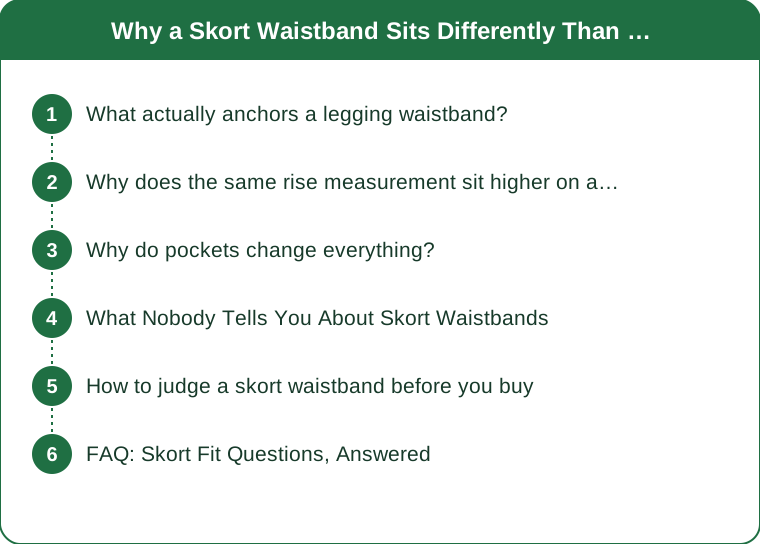
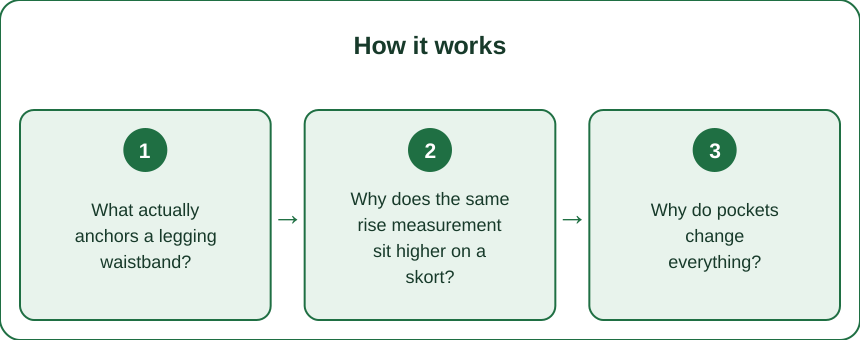
What actually anchors a legging waistband?
Tension from below, across the entire garment.
A legging is a closed system. The fabric wraps each leg from ankle to hip, and that whole surface is under mild tension against your body. The waistband is one part of a structure that is held in place by everything beneath it. If it starts to migrate, the fabric down the legs resists.
The practical consequence is that a legging waistband is doing relatively little work on its own. It shapes and finishes the top edge, and the body of the garment does the holding.
Now remove the legs. A skort has a waistband, a short liner that ends mid-thigh with a free hem, and a skirt layer that hangs entirely loose. Below the hip there is nothing gripping anything.
So the waistband becomes the sole anchor point for the whole garment, and it is now supporting downward load rather than being held by it. That is a completely different mechanical job performed by the same component.
Brands frequently use the same waistband specification across a range for consistency and cost. Which means the skort is often using a waistband engineered for a job it is no longer doing.
Why does the same rise measurement sit higher on a skort?
Two reasons that compound.
The garment is lighter below the waist. Rise is measured flat, but where a waistband settles on a body is decided by the balance between how much it grips and how much it is being pulled down. A legging carries the weight of two full legs of fabric plus whatever tension the fabric has; a skort carries a short liner and a light skirt. Less downward pull means the band settles higher on the natural waist.
There is no leg tension pulling it into shape. Legging fabric under tension around the thigh effectively pulls the waistband down and outward into a settled position. Without that, the band tends to migrate up towards the narrowest part of your torso, which is where any elastic band naturally wants to go.
The result is a skort whose waistband creeps up over an hour of wear while a legging in the same size stays put. It is not that the skort is smaller. It is that it has been released from the thing that was holding it down.
This also explains the frustrating variation between people. If you have a defined waist and a fuller hip, the band has an obvious high resting place to migrate to and it will find it. If your waist and hip measurements are closer, the same skort sits far more stably.
Why do pockets change everything?
Because a phone in a skort pocket is a point load on an unanchored system.
In a legging with a side pocket, the weight of a phone is distributed into fabric that is under tension all the way down the leg and around the hip. The garment absorbs it structurally, and the waistband barely notices.
In a skort, that same phone hangs on a liner that is attached to a waistband and to nothing else. The load transfers directly to one section of the band, which pulls down on one side, which tilts the whole thing. From there you get the familiar sequence: one side drops, the skirt rotates slightly, the liner shifts, and something starts riding up.
So three practical rules follow:
Test skorts with your actual phone in the pocket. A fitting-room assessment with empty pockets tells you very little about how you will experience it.
Prefer skorts with a compression liner that grips the thigh. A gripping liner reintroduces the anchoring that leggings have naturally, and it is by far the most effective structural fix available.
Distribute rather than concentrate. Two small items in two pockets behave far better than one heavy item in one — and if a skort has only one pocket, a phone is genuinely at the edge of what the design can carry well.

What Nobody Tells You About Skort Waistbands
Wide is not automatically better. A wide waistband distributes pressure well but has more surface to fold, and it rolls more readily when it is unanchored. On skorts, a slightly narrower band with a good internal elastic often outperforms a wide soft one — the reverse of the legging advice.
The liner attachment point matters more than the liner itself. If the liner is attached to the waistband at only the top edge, it hangs. If it is attached with the skirt layer as an integrated construction, the load shares. You can check this by turning the waistband inside out for two seconds in a fitting room.
Internal drawcords are not a gimmick here. On leggings they are usually decorative. On a skort, where the waistband is the only anchor, an internal cord is genuinely load-bearing and worth having.
The same brand’s tennis and running skorts often differ. Tennis skorts are typically built with more waistband structure because the sport involves more lateral movement and more ball-in-pocket load. Running skorts are lighter. Buying by brand rather than by line frequently produces the mismatch.
Seasonal shift catches people out. As you start wearing a skort over leggings or tights in cooler weather, you add a slippery layer between the waistband and your skin — and a waistband that gripped perfectly all summer can migrate constantly over a smooth base layer, which almost everyone blames on the skort rather than on the new surface underneath it.
How to judge a skort waistband before you buy
Five checks, about a minute, in the fitting room.
1. Put your phone in the pocket. Then walk. Not two steps — walk the length of the fitting area and back. Half of all skort waistband problems appear only under load, and none of them appear standing still.
2. Check the liner grip. Reach down and feel the hem of the inner short. Is there a silicone strip, an elasticated hem or a compressive fabric? If the liner hem is loose and unstructured, it will slide, and sliding liners drag the waistband.
3. Turn the waistband down. Look at whether the liner and the skirt are attached together or separately, and whether there is an internal elastic or just folded fabric. Thirty seconds of looking predicts a lot.
4. Do three lateral steps and a squat. Lateral movement is what tests a skort waistband, because the skirt swings and the liner does not. Forward walking hides problems that sideways movement exposes immediately.
5. Reach overhead. This is the roll test. A band that folds over on itself when you lift your arms will do so all day.
And the sizing note, since it is the change most people reach for first: if the waistband rolls or migrates, going up a size makes it worse, because you have reduced the only grip in the system. If it feels genuinely tight and leaves marks, size up. If it moves, size stays and you need a different construction.
The brand-consistency assumption is the underlying trap. Your size in that brand’s leggings is a reasonable starting point and nothing more — a skort is a different mechanical object wearing the same label.
FAQ: Skort Fit Questions, Answered
Should I size up in a skort compared to leggings?
Usually not, and often the opposite. The waistband is the only anchor, so it needs to grip. Most people who size up in skorts end up with more movement, not more comfort.
Why does my skort waistband roll only at the back?
Typically because there is more curve there for the band to travel over, and because the skirt layer’s weight distribution is rarely even front to back. A band with a slightly higher back rise, or a design with a seam at centre back, handles this considerably better.
Is a high-rise skort more stable than a mid-rise?
Generally yes, because a higher band sits at the narrowest part of the torso and has somewhere stable to rest. Mid-rise skorts sit on the widest part of the transition and migrate more.
Does the liner length affect the waistband?
Yes — longer liners have more surface area gripping the thigh, which anchors the garment better. A very short liner offers almost no anchoring and puts all the work back on the waistband.
Can I fix a migrating waistband on a skort I already own?
Partly. Wearing it with a slightly grippier base layer helps, as does moving your phone to a different pocket or carrying it elsewhere. If the liner hem is the loose type, that is the component doing the damage and it is not really fixable — which is worth knowing before you buy the same model again.
TL;DR:
- A legging waistband is held in place by the whole garment; a skort waistband is the only anchor and carries load
- Less downward pull and no leg tension means the same rise sits higher and migrates more
- Pockets concentrate load on an unanchored band, which is why a phone changes the fit dramatically
- A gripping liner hem is the most effective structural fix, because it restores the anchoring leggings have naturally
- If it rolls or migrates, sizing up makes it worse — you need a different construction, not a different number
Next time you try a skort, put your actual phone in the pocket and take three steps sideways. That one test predicts more about how you will feel in it than the entire fitting-room mirror check does.
See It in Motion
Seen here: Super High Waist Embossed Yoga Leggings with Inner Pocket — shop it on bubblelime.com
Keep Reading
This article is for general informational and styling purposes only. Fit, sizing, and product availability may vary.