Why a Skort's Flare Matters More Than Its Length
Quick Answer: Length determines coverage while you are standing still. Flare determines what happens when you move — how much the outer layer lifts, whether it catches on the inner short, and whether it twists as you walk. A straight or narrow skort at 15 inches can expose more in motion than a flared one at 13, which is why length-only shopping produces so many disappointing purchases.
Every skort product page leads with the length. Every review argues about whether 13 inches is too short. Almost nobody discusses the shape of the outer layer, which is the variable that decides how the garment behaves in the activity you bought it for.
A skort is two garments that have to cooperate. Flare is what determines whether they do.

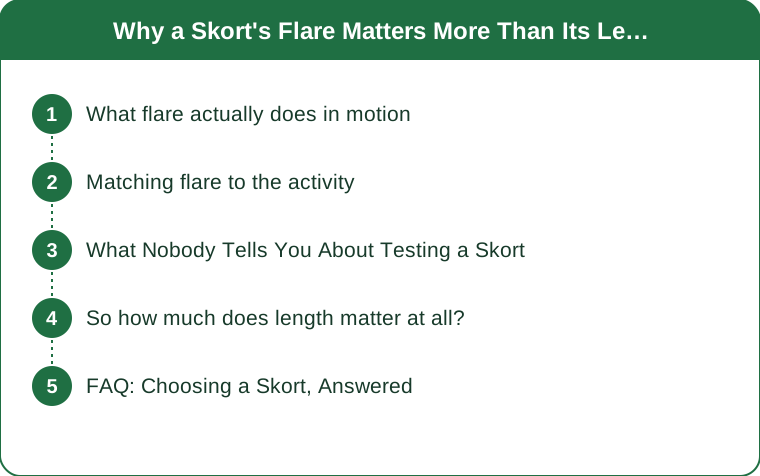
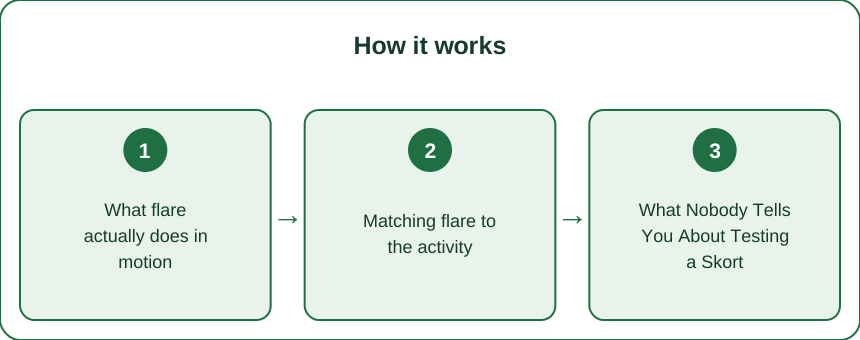
What flare actually does in motion
It controls the relationship between the outer layer and the inner short.
A flared, A-line outer layer moves independently. It swings away from the leg during a stride, then settles. Because it has room, it does not press against the inner short, which means the two layers are not gripping each other and dragging the inner short upward.
A straight or narrow outer layer sits close to the leg. It contacts the inner short across a large area, and when the two layers grip each other — especially once you are damp — the outer layer’s movement pulls the inner short with it. This is the actual mechanism behind the inner short riding up, and it is a flare problem far more often than a length or sizing problem.
There is a second effect. A narrow skort has to lift to allow a full stride, because the hem circumference is the limiting factor. The garment physically cannot let your leg travel without rising. A flared one has the circumference built in, so it stays put and the leg moves inside it.
Practical implication: for anything involving big strides — walking, hiking, running between points — flare matters more than any other spec on the page.
Matching flare to the activity
Different sports genuinely want different shapes, which is why one skort rarely covers everything.
Tennis and pickleball: moderate flare, pleated or paneled. Lateral movement and lunging need the outer layer to open in every direction, and pleats provide that without excess fabric flapping. Pleated tennis skorts exist for a mechanical reason, not a traditional one.
Golf: minimal to moderate flare, straighter cut. The swing needs a stable garment that does not billow, and golf involves far less explosive leg movement. This is the one case where a straighter cut is genuinely better.
Walking, hiking, travel: maximum flare. Long sustained strides over hours, and comfort matters more than anything aerodynamic. An A-line with real swing is the correct choice, and it is the case where a straight skort fails most obviously.
Running: moderate flare with a strong liner. You want movement freedom but not so much fabric that it becomes noise and drag. Look for a built-in short with a grippy hem rather than relying on the outer layer to behave.
Studio and gym: less important, since the outer layer is often a styling choice. Prioritize the liner.
The mistake most people make is buying a tennis skort for a walking holiday, or a golf skort for a tennis league. They are shaped for different motions.

What Nobody Tells You About Testing a Skort
The fitting room test everyone does — standing in front of the mirror checking the length — tests the one condition that matters least.
Do the walking test. Take ten full-length strides. Not shuffling steps. If the hem lifts significantly or you feel the inner layer moving, the flare is inadequate for anything involving distance.
Do the lunge test. Step into a deep lunge and hold. This shows you both the coverage limit and whether the outer layer catches on the inner short. Watch what the outer layer does, not just where the hem ends up.
Do the twist test. Rotate your torso hard both directions. A skort that twists so the side seams migrate toward the front is either too narrow or the waistband is not holding — both make for a miserable long day, and it is the failure people describe as the skirt spinning on me.
Check the layer separation with your hand. Reach between the outer layer and the inner short. There should be genuine space. If the two layers are pressed together standing still, they will be worse when you are warm and damp.
Check the inner short’s hem. A silicone gripper or a snug elastic hem on the inner short solves ride-up almost independently of the outer layer. If a skort has this, it can tolerate less flare. A loose-hemmed liner in a narrow skort is the worst combination available, and it is extremely common in cheaper skorts.
Together these take about ninety seconds and they predict the entire ownership experience far better than the number on the tag.
So how much does length matter at all?
It matters, but it is a coverage decision rather than a performance one, and it should be made second.
Pick the flare for your activity, then pick the length for your comfort. In that order. A well-flared 13-inch skort provides more real coverage in motion than a narrow 16-inch one, which is counterintuitive enough that most people get it backwards.
Inner short length should be shorter than the outer layer but not by much — roughly one to two inches. A liner much shorter than the skirt exposes itself during movement; a liner nearly the same length can peek at the hem, which many people dislike.
Longer is not automatically safer. A long, narrow skort restricts stride and rides up more, so you can end up with less coverage than you started with plus a garment that fights you.
Consider rise as the third variable. A higher rise keeps the waistband above the hip crease when you sit, which is where the twisting problem usually starts. On a long walking day, rise matters nearly as much as flare.
Length, flare, liner hem, and rise — those four in that order of importance for anything active, and length is genuinely the least of them.
FAQ: Choosing a Skort, Answered
Can I tell the flare from a product photo?
Sometimes. Look for a photo of the garment flat or on a model mid-movement rather than standing still. A flat lay that shows the hem noticeably wider than the waist indicates real A-line shape; a rectangle does not.
Are pleated skorts better than plain ones?
For lateral sports, generally yes — pleats give directional flare without bulk at the waist. For walking, a smooth A-line is usually more comfortable and less prone to catching.
My skort rides up no matter what. What should I look for?
A liner with a silicone or snug elastic hem, real separation between the layers, and more flare than you currently have. In that order. Sizing up rarely fixes it and often makes the twisting worse.
TL;DR:
- Length determines standing coverage; flare determines what happens in motion, which is what you actually experience.
- A narrow outer layer grips the inner short and drags it up — the real cause of most ride-up complaints.
- Match flare to activity: pleated moderate for tennis, straighter for golf, maximum A-line for walking and travel.
- Test with ten full strides, a deep lunge, and a torso twist, and check for genuine space between the layers.
- Priority order: flare, liner hem, rise, then length.
Stop shopping skorts by the inseam number. Take ten proper strides in the fitting room instead — it tells you everything the product page does not.
See It in Motion
Seen here: UPF 50+ Adjustable A-Line Running Skort with Pockets — shop it on bubblelime.com
Keep Reading
This article is for general informational and styling purposes only. Fit, sizing, and product availability may vary.