Why the Shorts Under a Skort Matter More Than the Skirt Over Them
Quick Answer: A skort is two garments — and the inner short is the one doing the actual work: thigh coverage, chafe protection, secure pockets, and the confidence to move without a second thought. The skirt is styling; the shorts are function. Yet skorts get bought on skirt length and print, which is why so many end up abandoned over ride-up, too-short liners, or phone pockets that bounce. Judging a skort means turning it inside out first: liner length against your stride, leg-opening grip, fabric weight, and pocket placement — the same inspection you would give any biker shorts, because that is what you are really buying.
Here is what the inner short controls, and the inside-out buying checklist.

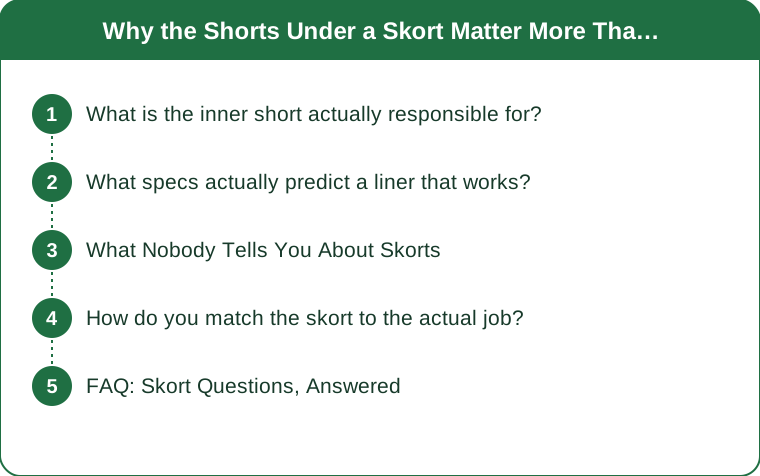
What is the inner short actually responsible for?
Everything the skirt gets credit for. The skirt is the press office; the short is the operations team.
Coverage in motion. The skirt panel lifts, swings, and flips with every lunge, gust, and bike ride — that is its nature, and a good skort is designed around the assumption. The liner is what makes the flip a non-event: the coverage you are actually trusting on the pickleball court or the playground is the short, full stop. Which reframes the shopping question — the skirt length debate matters less than whether the liner underneath is one you would happily be seen in for the half-second the skirt misbehaves.
Chafe protection, the make-or-break for most women. Inner thighs that touch — which is most inner thighs — need smooth fabric between them for any walk past twenty minutes. The liner is that fabric, and its length decides whether protection exists where your thighs actually meet. A liner that ends above the contact zone provides décor, not protection; a liner reaching mid-thigh converts skin-on-skin into fabric-on-fabric, which is the entire anti-chafe mechanism. This is why skort satisfaction correlates with liner length far more than with any visible feature.
Cargo duty. On the best skorts, the liner carries the pockets — a phone sleeve on the thigh, a ball pocket for tennis and pickleball, a zip nook for keys. Liner pockets hold cargo against the body, nearly bounce-free, exactly like the thigh pocket on good yoga pants — while skirt-layer pockets swing their contents with every step.
Staying put. Ride-up — the liner crawling upward until it bunches — is the number-one skort complaint, and it is a liner spec problem: leg openings without grip, fabric too light for the job, or a cut too small for the thigh it circles. The skirt hides the evidence, but your hands know: a skort you tug at every few minutes has failed at the liner level, whatever the outside looks like.
What specs actually predict a liner that works?
Five, all checkable in a fitting room — four of them by feel.
Length against your stride, not the size chart. The liner must cover your thigh contact zone at full stride — lunge in the fitting room and check where it sits at maximum extension. For most women that means a liner in the five-to-seven-inch inseam family; the barely-there three-inch liners common in fashion skorts are where chafe complaints are born. If you love a shorter-liner skort anyway, know you are buying it for low-friction days.
Grip or fit at the leg opening. Ride-up prevention comes from either silicone-dot or elastic-free wide-band leg openings, or simply a well-cut opening matched to your thigh. The test: five squats and ten walking steps — a liner that migrated in the fitting room will migrate every mile after. No amount of tugging discipline fixes a gripless opening.
Fabric with real weight. Flimsy, featherweight liners twist, roll, and ride; liners in substantial compression knit — biker-short weight — hold position and smooth the ride. Pinch the liner fabric and the skirt fabric: on a quality athletic skort the liner feels like the more serious garment of the two, closer to buttery-soft leggings fabric than to swimsuit lining.
Pocket placement you would actually use. Thigh phone pocket on the liner: gold standard, bounce-free, usable mid-activity. Pockets only in the skirt layer: fine for lip balm, wrong for a phone. No pockets at all is a fair choice for pure sport skorts — but decide it consciously, since the pocket is half the reason skorts beat skirts.
The waistband as one system. Liner and skirt should share one wide, flat waistband — high-rise for most preferences — so the two layers move as one garment. Skorts where the liner hangs separately from a thin band telegraph every movement and bunch at the waist under a tucked shirt.
Run the sequence in this order and the fitting room takes four minutes: lunge for length, squat for grip, pinch for weight, load your actual phone into the pocket, and finish with a twirl to confirm the skirt does its one job — swinging prettily over a liner that never needed the skirt’s protection anyway.

What Nobody Tells You About Skorts
The liner wears out first, invisibly. Elastane in the liner fatigues from exactly the loads the skirt never carries — stretch, friction, wash cycles — so a two-year skort often has a perfect skirt over a slack, riding liner. That is why an old favorite starts creeping: the operations team retired while the press office stayed photogenic. Retirement decision belongs to the liner.
Skorts solved the bike-and-playground problem better than shorts did. The specific use case where skorts beat everything: activities with bending, climbing, and sitting on public surfaces around other people — playground parenting, casual cycling, golf, gardening. Full coverage in motion plus a put-together standing appearance is a genuinely rare combination, and it is the liner-skirt partnership delivering both halves.
The pickleball boom quietly upgraded the entire category. Court sports demand real liners — ball pockets, grip hems, serious fabric — and the wave of court skorts raised the baseline so much that the best sport skorts now out-spec most casual biker shorts. If your skorts are all fashion-line leftovers, the athletic aisle has been improving without you.
Liner and skirt lengths are separate decisions brands make independently. A longer skirt over a short liner looks modest and chafes; a shorter skirt over a longer liner looks sporty and protects. Read both numbers — the pairing tells you who the skort was actually designed for.
You can retrofit a failed liner. A beloved skort with a dead or too-short liner is not landfill: wear fitted biker shorts under it and let the built-in liner ride along, or snip a truly offensive liner out at the seam and pair the skirt shell with shorts you trust. The reverse — adding a skirt over great shorts — is literally how the garment was invented.
Dark liners under light skirts show at every flip. Match liner-to-skirt tone when you can; contrast liners turn the skirt’s every swing into an announcement. Tonal liners keep the flip boring, which is the goal.
How do you match the skort to the actual job?
By deciding which layer works harder that day — and buying accordingly.
Court sports — tennis, pickleball, padel: liner does heavy labor. Spec for grip hems, a ball pocket, compression-weight fabric, and a liner long enough for lunges and low balls. Skirt stays shorter and swingy for range; pleats and flounce are legitimately functional here, adding coverage without restricting stride.
Running and cardio: the liner is everything — this is where a skort must effectively be good running shorts wearing a skirt. Demand the full anti-chafe spec: longer liner, grippy openings, flat seams, thigh phone pocket. If a running skort’s liner would not pass as standalone biker shorts, the skirt is decoration on a future regret.
Golf and walking: balance shifts toward the skirt — length rules at many courses, pockets for tees and cards, wind resistance in the panel. The liner still sets comfort for eighteen holes of walking, so mid-length with modest grip is the sweet spot; maximum compression is unnecessary.
Errands, travel, and playground duty: the everyday skort is the category most people under-spec. Prioritize the phone pocket, a liner that survives car seats and cross-legged floor sitting without riding, and fabric weights that read as clothing rather than gear. This is also where the skort quietly outperforms the sundress and the denim short simultaneously — one garment covering the bend-lift-sit-chase gamut while looking deliberate at school pickup.
Late summer into fall, the transition trick: skorts extend past shorts season by simply adding layers below and above — the skirt panel over opaque tights or full-length leggings come October is a legitimate outfit in the same way it works over bare legs in August. A skort wardrobe bought on liner quality serves three seasons; one bought on prints serves the photos.
Whichever job you shop for, the ritual stays identical: flip it inside out first, judge the short like you were buying only the short — because functionally, you are — and let the skirt be the tiebreaker between finalists, never the qualifier.
FAQ: Skort Questions, Answered
Why does my skort ride up when I walk but not at the store?
Store trials are two minutes; walking is thousands of strides warming and flexing the fabric. Marginal grip fails cumulatively — which is why the fitting-room test is squats and steps, not standing. A liner that moved even slightly in-store is announcing its plans for mile two.
Skort versus dress with shorts underneath — which wins?
Same philosophy, different integration: the skort’s shared waistband keeps layers moving as one and carries pockets on the liner, while separates let you pick each layer’s exact spec. For sport, the integrated skort wins; for styling range, separates. The failure mode to avoid is the same in both: an under-short too short or too slippery to do its one job.
Can I wear a skort for serious workouts or is it just a look?
Sport-line skorts are engineered exactly for it — court skorts take lateral lunges all match long. The audit is liner-only: length, grip, fabric, seams. If the liner spec matches what you would demand from standalone training shorts, the skirt subtracts nothing but modesty-anxiety, which is rather the point.
How should a skort fit at the waist compared to shorts?
Identically to your best high-waisted bottoms: wide flat band, sitting where you would wear yoga pants, no fold-over, no gap at the small of the back. The skort adds a layer of fabric but should never add a layer of waistband negotiation — if the band digs or flips in the fitting-room sit test, the two-garment construction is fighting itself and will fight you all day.
TL;DR:
- A skort is two garments and the inner short does the real work: coverage in motion, chafe protection, bounce-free pockets, and staying put.
- Spec the liner like standalone biker shorts: length checked at full lunge, grip checked with squats, substantial fabric by pinch test, phone pocket on the thigh, one shared waistband.
- Liners age faster than skirts — creeping ride-up in an old favorite is liner retirement, and biker shorts underneath is the legitimate retrofit.
- Match the balance to the job: liner-heavy for running and court sports, skirt-forward for golf, pocket-first for everyday — and over leggings, the same skorts run into fall.
Next skort you consider, flip it inside out before you look at the print. Two minutes with the layer nobody photographs decides whether you wear it all season or donate it by October.
See It in Motion
Seen here: High Waist Yoga Leggings with Side Pockets — shop it on bubblelime.com
Keep Reading
This article is for general informational and styling purposes only. Fit, sizing, and product availability may vary.